
MiniMax M3 vs Kimi K2.6: Long-Context and Coding Comparison
MiniMax M3 vs Kimi K2.6: 1M vs 256K context and SWE-Bench Pro 59.0% vs 58.6%. Specs, when to choose each, routing, and what to test before production.
Quick answer
MiniMax M3 and Kimi K2.6 finish within a point on coding and terminal benchmarks, so the deciding difference is context: 1M tokens for M3 versus 256K for Kimi K2.6. Neither is universally better.
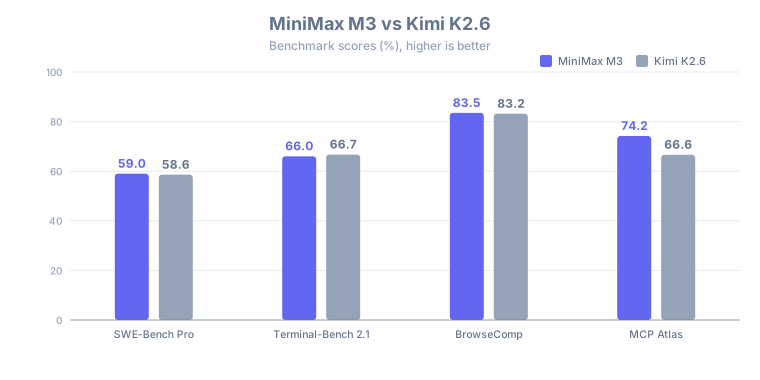
- Pick MiniMax M3 when tasks need a large context or strong tool use. It leads MCP Atlas (74.2% vs 66.6%) and SWE-Bench Pro (59.0% vs 58.6%), with a 1M-token window.
- Pick Kimi K2.6 if you already run Moonshot models and your prompts fit in 256K. It edges Terminal-Bench 2.1 (66.7% vs 66.0%).
- Decide by context need, not by tenths of a point on a single score.
- Watch cost per completed task, since longer context adds latency and spend.
Confirmed facts
Scores come from MiniMax's official June 1, 2026 release table. Bold marks the higher value in each row; a dash marks a metric not reported for that model in the cited source.
| Area | MiniMax M3 | Kimi K2.6 |
|---|---|---|
| SWE-Bench Pro | 59.0 | 58.6 |
| Terminal-Bench 2.1 | 66.0 | 66.7 |
| BrowseComp | 83.5 | 83.2 |
| MCP Atlas | 74.2 | 66.6 |
| Context window | 1M tokens | 256K tokens |
| Input modalities | Text, image, video | Not reported |
Why this comparison matters
On the narrow coding and terminal scores the two are within a point, so the 256K-to-1M context jump and the MCP Atlas gap (74.2% vs 66.6%) are the more decisive signals. In MiniMax's table, M3's 59.0% on SWE-Bench Pro narrowly tops the open-access group (GLM 5.1 at 58.4%, DeepSeek V4 Pro at 55.4%) and sits just ahead of GPT-5.5. Frontier closed models like Claude Opus 4.8 lead on raw coding (around 69.2% on SWE-Bench Pro per third-party reports) at far higher cost. See the full MiniMax M3 benchmark table for every row.
When MiniMax M3 is the right default
Make M3 your default when context and tool use carry the task:
- Full-repository analysis and long transcripts. The 1M-token window keeps the issue, code, logs, and prior conversation in one prompt.
- Tool-connected agents. M3's MCP Atlas lead (74.2% vs 66.6%) is its largest margin over Kimi K2.6.
- Multimodal input. Native text, image, and video input are on M3's spec sheet, not Kimi's in this source.
- Long-horizon runs. M3 posted a reported 24-hour autonomous run with nearly 2,000 tool calls.
On OpenRouter, M3 lists at $0.30 per 1M input and $1.20 per 1M output during its launch promotion; see the MiniMax M3 price guide.
When Kimi K2.6 is worth it
Reach for Kimi K2.6 when:
- You already run Moonshot models and have prompts and tooling built around them.
- Your context fits in 256K. Short Q&A, single-file edits, and ordinary summaries rarely need a 1M window.
- Terminal work is central, where Kimi edges Terminal-Bench 2.1 (66.7% vs 66.0%).
Confirm whether your tasks actually use distant context before paying for the larger window.
Practical routing pattern
| Workload | First choice | Why it matters |
|---|---|---|
| Full-repo or long-transcript tasks | MiniMax M3 | 1M context vs 256K |
| Tool-connected agents | MiniMax M3 | Leads MCP Atlas (74.2% vs 66.6%) |
| Multimodal coding (image or video) | MiniMax M3 | Native text, image, and video input |
| Terminal and shell work | Kimi K2.6 | Edges Terminal-Bench 2.1 (66.7%) |
| Existing Moonshot stack, short tasks | Kimi K2.6 | 256K is enough, keep your tooling |
What to test before production
| Test | Why it matters |
|---|---|
| Long-context recall | Confirms the model uses distant info, not just a large window |
| Tool-call reliability | M3's largest lead is on MCP Atlas |
| Same task traces on both models | Cross-vendor benchmarks use different harnesses |
| Cost and latency at long context | A 1M window adds spend and response time |
| Cost per completed task | Token price misses retries and human review |
FAQ
What is the main difference between MiniMax M3 and Kimi K2.6?
Context window. M3 offers a 1M-token context versus 256K for Kimi K2.6. On coding and terminal scores the two are within a point (SWE-Bench Pro 59.0% vs 58.6%), so context length and MCP Atlas (74.2% vs 66.6%) are the deciding signals.
Does MiniMax M3 beat Kimi K2.6 on benchmarks?
It depends on the task. M3 leads SWE-Bench Pro (59.0% vs 58.6%), BrowseComp (83.5% vs 83.2%), and MCP Atlas (74.2% vs 66.6%). Kimi K2.6 edges Terminal-Bench 2.1 at 66.7% versus 66.0%. Most coding gaps are under a point.
When does the 1M context window actually matter?
When a full issue, the relevant code, logs, and prior conversation must fit in one prompt. Short Q&A and single-file edits rarely show the advantage. Longer context also adds cost and latency, so confirm the model uses distant information before assuming a bigger window helps.
Which is cheaper to run?
Pricing depends on provider and token usage. On OpenRouter, M3's launch promotion is $0.30/$1.20 per 1M input/output tokens, and M-Chat sells its own usage credits on top. The cited source does not list Kimi K2.6 pricing, so compare cost per completed task; see the MiniMax M3 price guide.