
MiniMax M3 vs GLM 5.1: Coding and Agentic Comparison
MiniMax M3 vs GLM 5.1: M3 leads every reported row, including SWE-Bench Pro 59.0% vs 58.4%. Specs table, when to choose each, routing, and FAQ.
Quick answer
MiniMax M3 vs GLM 5.1 is one of the closest open-access coding comparisons in MiniMax's release table, but M3 leads every reported row. Neither wins by much, so workload and tooling decide.
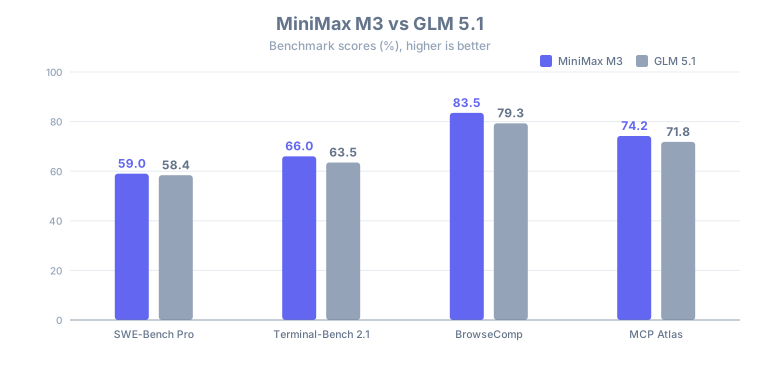
- Pick MiniMax M3 for the broadest coverage. It leads SWE-Bench Pro (59.0% vs 58.4%), BrowseComp (83.5% vs 79.3%), and MCP Atlas (74.2% vs 71.8%), and adds a 1M-token context with multimodal input.
- Pick GLM 5.1 if it is already in your stack and the half-point gaps do not justify a migration.
- Mind the license. M3 is an open-weight release, not a full open-source license.
- Watch cost per completed task, not a single benchmark.
Confirmed facts
Scores come from MiniMax's official June 1, 2026 release table. Bold marks the higher value in each row; a dash marks a metric not reported for that model in the cited source.
| Area | MiniMax M3 | GLM 5.1 |
|---|---|---|
| SWE-Bench Pro | 59.0 | 58.4 |
| Terminal-Bench 2.1 | 66.0 | 63.5 |
| BrowseComp | 83.5 | 79.3 |
| MCP Atlas | 74.2 | 71.8 |
| KernelBench Hard | 28.8 | - |
| Context window | 1M tokens | Not reported |
| Input modalities | Text, image, video | Not reported |
Why this comparison matters
The SWE-Bench Pro gap is just 0.6 points, but it widens on BrowseComp (4.2 points) and MCP Atlas (2.4 points). Pulling back, M3's 59.0% narrowly tops the open-access group it is usually measured against (Kimi K2.6 at 58.6%, DeepSeek V4 Pro at 55.4%) and sits just ahead of GPT-5.5. Frontier closed models such as Claude Opus 4.8 lead on raw coding (around 69.2% on SWE-Bench Pro per third-party reports) but cost far more. The full MiniMax M3 benchmark table has every row.
When MiniMax M3 is the right default
Make M3 your default when you want the widest coverage from one model:
- Browser and tool-use agents. M3's BrowseComp and MCP Atlas leads are its largest margins over GLM 5.1.
- Long-context and multimodal work. A 1M-token window plus native text, image, and video input are on M3's spec sheet, not GLM's in this source.
- Mixed task loads. When a team runs review, terminal, and agent tasks through one endpoint, M3's broad lead reduces routing complexity.
On OpenRouter, M3 lists at $0.30 per 1M input and $1.20 per 1M output during its launch promotion; see the MiniMax M3 price guide.
When GLM 5.1 is worth it
Stay on GLM 5.1 when:
- It already runs in production. Tooling, prompt libraries, and team familiarity outweigh a half-point benchmark gap.
- Licensing terms matter. If your use case needs GLM's specific license, that can outrank raw scores. M3 ships open-weight, which is not a full open-source license.
- Your tasks are short-context coding, where the 1M window and multimodal input are not in play.
Run both on the same prompts for a week before deciding a switch is worth it.
Practical routing pattern
| Workload | First choice | Why it matters |
|---|---|---|
| Browser and tool-use agents | MiniMax M3 | Largest leads (BrowseComp, MCP Atlas) |
| Repo-wide review or Q&A | MiniMax M3 | SWE-Bench Pro lead plus 1M context |
| Multimodal coding (image or video) | MiniMax M3 | Native text, image, and video input |
| Existing GLM stack, short tasks | GLM 5.1 | Half-point gaps rarely justify migration |
| License-constrained deployment | Whichever license fits | Terms can outrank benchmark scores |
What to test before production
| Test | Why it matters |
|---|---|
| Same task traces on both models | Cross-vendor benchmarks use different harnesses |
| Tool-call reliability | M3's largest leads are on agent and browse tasks |
| License review | Open-weight is not the same as full open-source |
| Cost per completed task | Token price misses retries and human review |
| Latency under long prompts | Affects developer flow and agent loops |
FAQ
Is MiniMax M3 better than GLM 5.1?
In MiniMax's cited table, M3 leads every reported row: SWE-Bench Pro 59.0% vs 58.4%, Terminal-Bench 2.1 66.0% vs 63.5%, BrowseComp 83.5% vs 79.3%, and MCP Atlas 74.2% vs 71.8%. The SWE-Bench Pro gap is only 0.6 points, so test both on your own tasks.
How big is the MiniMax M3 vs GLM 5.1 gap?
The closest metric is SWE-Bench Pro at 0.6 points. The gap widens to 4.2 points on BrowseComp and 2.4 points on MCP Atlas, where M3 leads. GLM 5.1's KernelBench Hard and context length are not reported in the cited source.
Is MiniMax M3 fully open source?
Not exactly. Outlets like Open Source For You note that M3 ships as an open-weight release, which is not a full open-source license. For GLM users, license terms and existing tooling often matter as much as a half-point benchmark difference.
Which is cheaper to run?
Pricing depends on provider and token usage. On OpenRouter, M3's launch promotion is $0.30/$1.20 per 1M input/output tokens, and M-Chat sells its own usage credits on top. The cited source does not list GLM 5.1 pricing, so compare cost per completed task; see the MiniMax M3 price guide.