
MiniMax M3 vs DeepSeek V4 Pro: Benchmarks and Practical Choice
MiniMax M3 vs DeepSeek V4 Pro: M3 leads SWE-Bench Pro 59.0% vs 55.4%, DeepSeek leads Terminal-Bench. Specs, routing, and what to test before production.
Quick answer
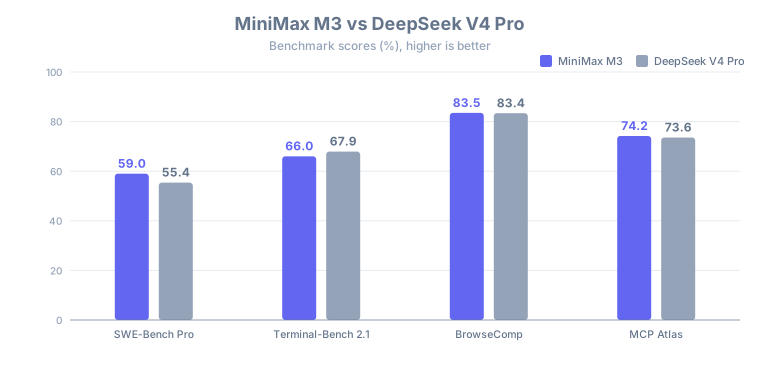
MiniMax M3 and DeepSeek V4 Pro are both open-access coding models, and in MiniMax's own release table they finish within about a point on most benchmarks. Neither is universally better; the right pick depends on the workload.
- Pick MiniMax M3 for code review, repository Q&A, long-context planning, or multimodal input. It leads SWE-Bench Pro (59.0% vs 55.4%) and ships a 1M-token context window.
- Pick DeepSeek V4 Pro for terminal-heavy work. It leads Terminal-Bench 2.1 (67.9% vs 66.0%) in the same table.
- Use both and A/B on your own prompts, since cross-vendor scores run on different harnesses.
- Watch cost per completed task, not the per-token price or a single benchmark. A cheaper model that retries more can erase its savings.
Confirmed facts
Scores come from MiniMax's official June 1, 2026 release table. Bold marks the higher value in each row; a dash marks a metric not reported for that model in the cited source.
| Area | MiniMax M3 | DeepSeek V4 Pro |
|---|---|---|
| SWE-Bench Pro | 59.0 | 55.4 |
| Terminal-Bench 2.1 | 66.0 | 67.9 |
| BrowseComp | 83.5 | 83.4 |
| MCP Atlas | 74.2 | 73.6 |
| KernelBench Hard | 28.8 | - |
| Context window | 1M tokens | Not reported |
| Input modalities | Text, image, video | Not reported |
Why this comparison matters
Both models target the value tier: near-frontier coding without frontier pricing. In MiniMax's table, M3's 59.0% on SWE-Bench Pro narrowly tops the open-access group (GLM 5.1 at 58.4%, Kimi K2.6 at 58.6%) and sits just ahead of GPT-5.5. Frontier closed models still lead on raw coding, with third-party reports putting Claude Opus 4.8 near 69.2% on SWE-Bench Pro, but they cost far more. So this is a contest inside the value tier, where context length, multimodality, and cost per task matter more than tenths of a point. The full MiniMax M3 benchmark table lists every row.
When MiniMax M3 is the right default
Make M3 your default when the work rewards context and breadth:
- Code review and repository Q&A. The SWE-Bench Pro lead (59.0% vs 55.4%) plus a 1M-token window let it hold a whole codebase in one prompt.
- Long-context planning. Design docs, logs, and prior conversation fit in a single session.
- Multimodal input. Screenshots, diagrams, or video frames alongside code, which the cited DeepSeek spec sheet does not cover.
- Tool-connected agents. M3 leads MCP Atlas (74.2% vs 73.6%) and posted a reported 24-hour autonomous run with nearly 2,000 tool calls.
On OpenRouter, M3 lists at $0.30 per 1M input and $1.20 per 1M output during its launch promotion; see the MiniMax M3 price guide before budgeting.
When DeepSeek V4 Pro is worth it
Reach for DeepSeek V4 Pro when:
- Terminal and shell work dominate. It leads Terminal-Bench 2.1 (67.9% vs 66.0%) in the cited table.
- You already run DeepSeek in production. Existing tooling, prompts, and team workflow are real switching costs.
- Tasks are short-context, where M3's 1M window is not the deciding factor and the two finish within a point on coding scores.
Run your own command-line eval to confirm the terminal edge on your stack before you commit.
Practical routing pattern
| Workload | First choice | Why it matters |
|---|---|---|
| Repo-wide review or Q&A | MiniMax M3 | SWE-Bench Pro lead plus 1M context |
| Terminal and shell automation | DeepSeek V4 Pro | Leads Terminal-Bench 2.1 (67.9%) |
| Browser and tool-use agents | MiniMax M3 | Leads BrowseComp and MCP Atlas |
| Multimodal coding (image or video) | MiniMax M3 | Native text, image, and video input |
| Existing DeepSeek stack | DeepSeek V4 Pro, then trial M3 | Keep tooling, A/B before switching |
What to test before production
| Test | Why it matters |
|---|---|
| Same task traces on both models | Cross-vendor benchmarks use different harnesses |
| Tool-call reliability | MCP and agent success drive real throughput |
| Long-context recall | Confirms the model uses distant info, not just a large window |
| Cost per completed task | Token price misses retries and human review |
| Latency under long prompts | Affects developer flow and agent loops |
FAQ
Is MiniMax M3 better than DeepSeek V4 Pro for coding?
On SWE-Bench Pro, MiniMax reports M3 at 59.0% versus DeepSeek V4 Pro at 55.4%, so M3 leads real software-engineering fixes. The two are within a point on BrowseComp and MCP Atlas, and DeepSeek leads Terminal-Bench 2.1, so test both on your own tasks.
Where does DeepSeek V4 Pro beat MiniMax M3?
In the cited MiniMax table, DeepSeek V4 Pro leads Terminal-Bench 2.1 at 67.9% against M3's 66.0%. That makes terminal and shell automation its clearest edge. On BrowseComp (83.5% vs 83.4%) and MCP Atlas (74.2% vs 73.6%) the gap is a fraction of a point.
Which model is cheaper to run?
Pricing depends on your provider and token usage, not benchmarks. On OpenRouter, M3's launch promotion is $0.30/$1.20 per 1M input/output tokens, and M-Chat sells its own usage credits on top. The cited source does not list DeepSeek V4 Pro pricing, so compare cost per completed task; see the MiniMax M3 price guide.
Can I use MiniMax M3 with my existing DeepSeek setup?
Plan for an integration switch, not a drop-in swap. Model constants should resolve to minimax/minimax-m3, the provider moves from the DeepSeek API to OpenRouter, and any deepseek_api_key or DeepSeek base URL should be removed from settings.