
MiniMax M3 Price: API Token Costs and How to Budget
MiniMax M3 price across OpenRouter and the official MiniMax API, how it compares to Claude Opus 4.8 and GPT-5.5 on cost, M-Chat credits, and what the community says.
MiniMax M3 Price: What It Costs and How to Budget
MiniMax M3 price depends on which access route you use. On OpenRouter, the model is listed as minimax/minimax-m3 at $0.30 per 1M input tokens and $1.20 per 1M output tokens during the displayed discount period. The official MiniMax release also describes a Token Plan whose rate depends on input length, with standard pricing at or below 512K input tokens and higher long-context rates above that threshold. Because direct MiniMax plans and OpenRouter billing are separate products, you should never collapse them into a single number.
MiniMax M3 price on OpenRouter
For MiniMax M3, the practical integration price to watch is the OpenRouter listing rather than a direct MiniMax invoice. OpenRouter also reports the 1M-token context window and exposes a unified API route. If OpenRouter changes the price, provider availability, or discount state, your live bill can move before any static blog post catches up. Treat the figures here as a sourced snapshot from June 1, 2026 and re-verify before production budgeting.
The official MiniMax API price table
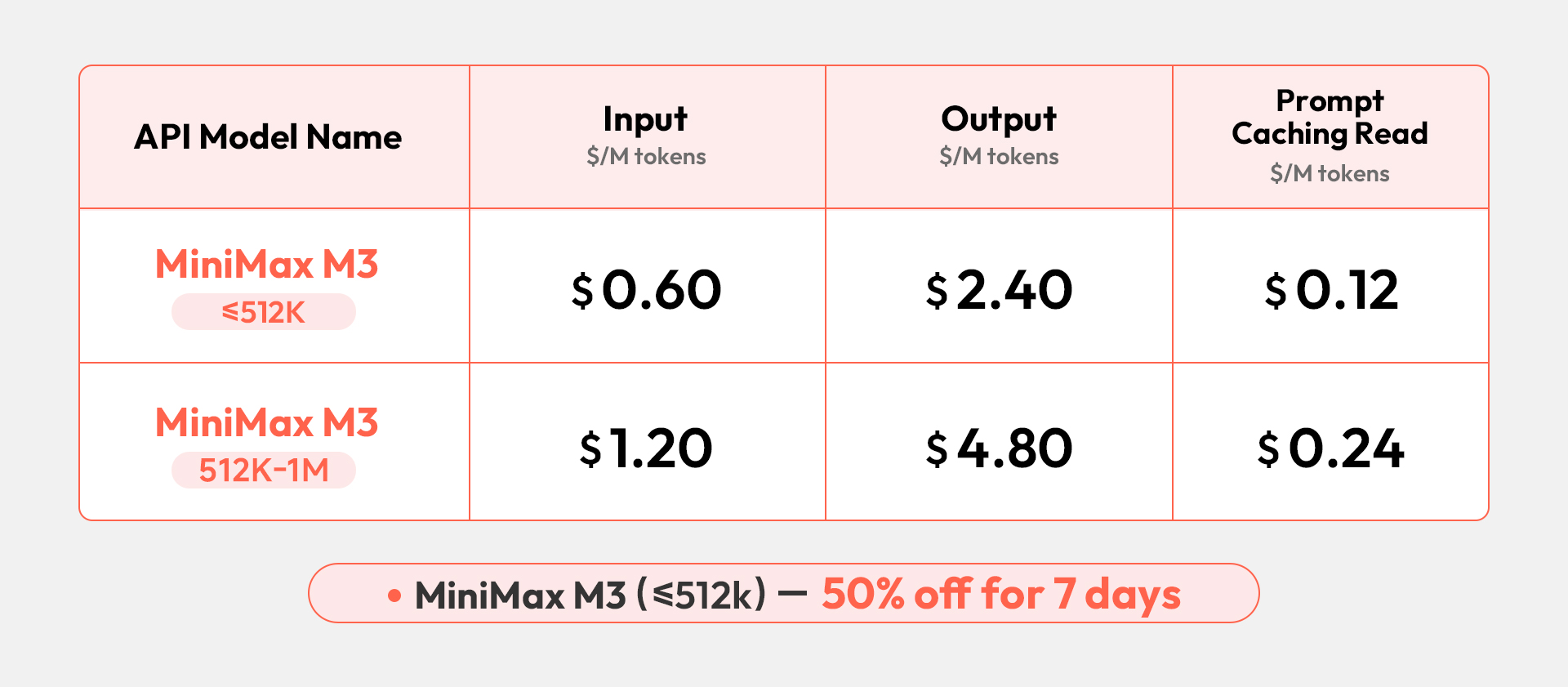
The MiniMax M3 report includes a direct MiniMax API price table. For <=512K input, it lists $0.60/M input tokens, $2.40/M output tokens, and $0.12/M prompt-caching read; for 512K-1M input, it lists $1.20/M input, $4.80/M output, and $0.24/M prompt-caching read. The image also marks a 50% discount for 7 days on the <=512K tier. These belong to the direct MiniMax API context and should not be mixed with OpenRouter's current $0.30/M input and $1.20/M output without checking both routes.
How MiniMax M3 pricing compares
The reason MiniMax M3 pricing became a talking point is the gap with frontier closed models. VentureBeat reported that M3 reaches comparable performance on key benchmarks "for just 5-10% of the cost." As a concrete reference, third-party launch coverage put Claude Opus 4.8 at roughly $5/$25 per million input/output tokens — so M3's promotional $0.30/$1.20 on OpenRouter is on the order of 15-20x cheaper per output token. GPT-5.5 also sits well above M3 on price. The caveat is the same one every cost model needs: the right metric is cost per completed task, not the per-token sticker, because a cheaper model that needs more retries can erase its own savings.
M-Chat credits versus token price
M-Chat credits are a product-layer abstraction, not the upstream token meter. In the local implementation, MiniMax M3 chat has a base credit cost, Thinking adds a small surcharge, and web search adds another because the server retrieves live results before generation. That is easier for a user interface, but teams doing cost modeling should still estimate prompt length, output length, cache behavior, search volume, and retry frequency. The useful question is not only "how cheap is a million tokens," but "how many successful tasks do we get per dollar."
What the community says about MiniMax M3 pricing
Price dominated the early reception. M3 launched on OpenRouter with a temporary 50% promotion, and outlets like The Information framed the release as intensifying the "open-source AI coding battle" largely on cost-performance. YouTube reviewers leaned into the same angle, with several headlining a "much cheaper than Opus" comparison after hands-on tests. Treat those promotional and launch-week figures as time-bound: discounts expire, and provider rates on OpenRouter can change, so confirm the live number before committing a budget.